

For commercial property owners, developers, and HOA board members in Florida, the term “structural engineering” has taken on a new and urgent meaning. The state’s evolving regulatory landscape, driven by the Florida Building Safety Act (SB-4D), has transformed structural oversight from an elective maintenance consideration into a mandatory compliance necessity. Navigating these complex building codes, stringent hurricane resilience requirements, and time-sensitive safety inspections now requires expert structural engineering guidance to protect both physical assets and financial liability.
In this demanding environment, structural engineering services are no longer just about design and construction. They have become a critical forensic discipline focused on preserving the integrity of aging coastal infrastructure. This comprehensive guide details the essential structural engineering services required for Florida commercial and multi-family assets, outlining the path to regulatory compliance, long-term safety, and asset stability.
Structural Engineering Services for Florida’s Evolving Regulatory Landscape
In the context of Florida’s commercial and multi-family assets, Structural engineering services encompass a specialized set of disciplines designed to ensure a building’s safety, stability, and legal compliance throughout its lifecycle. This field has fundamentally shifted from a primary focus on new construction design to a critical role in the assessment, maintenance, and retrofitting of existing structures. The catalyst for this change has been a series of legislative actions aimed at preventing catastrophic failures in high-rise and coastal buildings.
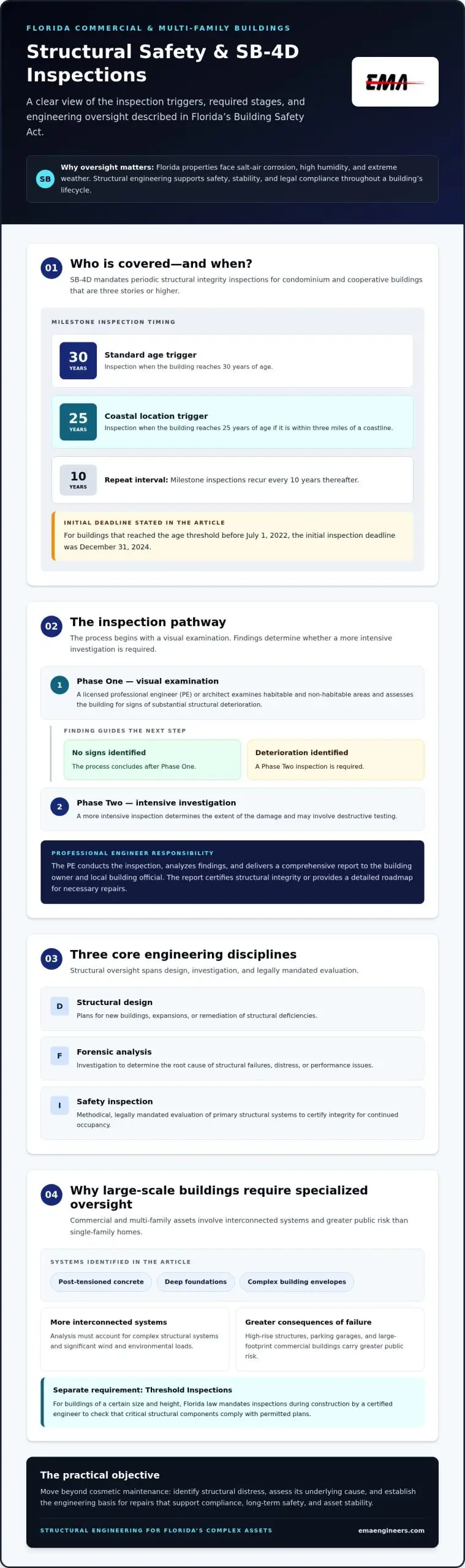
Professional engineering oversight is now indispensable for these assets, which face unique environmental stressors like salt-air corrosion, high humidity, and extreme weather events. The technical disciplines involved can be broadly categorized:
- Structural Design: The foundational practice of creating plans for new buildings, expansions, or the remediation of structural deficiencies.
- Forensic Analysis: An investigative discipline focused on determining the root cause of structural failures, distress, or performance issues.
- Safety Inspection: The methodical, legally mandated evaluation of a building’s primary structural systems to certify its integrity for continued occupancy.
The Impact of SB-4D on Florida Property Owners
The Florida Building Safety Act, commonly known as SB-4D, represents a landmark change in property management responsibility. Enacted in response to the Surfside condominium collapse, this legislation mandates periodic structural integrity inspections for condominium and cooperative buildings that are three stories or higher. For property owners and association boards, understanding its implications is not optional—it is a legal requirement with firm deadlines.
- Summary of the Act: SB-4D requires buildings to undergo a “Milestone Inspection” once they reach 30 years of age (or 25 years if located within three miles of a coastline) and every 10 years thereafter. The deadlines for initial inspections for buildings that reached this age before July 1, 2022, are set for December 31, 2024.
- Phase One and Phase Two Inspections: The process is divided into two stages. A Phase One inspection is a visual examination by a licensed professional engineer (PE) or architect to assess the habitable and non-habitable areas of a building. If no signs of substantial structural deterioration are found, the process concludes. However, if such deterioration is identified, a more intensive Phase Two inspection is required, which may involve destructive testing to determine the extent of the damage.
- The Role of the Professional Engineer (PE): A licensed PE is central to the SB-4D process. The engineer is responsible for conducting the inspection, analyzing the findings, and delivering a comprehensive report to the building owner and the local building official. This report certifies the building’s structural integrity or provides a detailed roadmap for necessary repairs to restore it.
Commercial vs. Residential Engineering Scope
The engineering principles applied to large-scale commercial and multi-family assets differ significantly from those for single-family homes. The complexity of high-rise structures, parking garages, and large-footprint commercial buildings demands a higher tier of analysis due to greater public risk, more complex load-bearing systems, and the severe consequences of failure.
- Higher-Tier Analysis: Multi-family and commercial buildings involve intricate structural systems, including post-tensioned concrete, deep foundations, and complex building envelopes that must withstand significant wind and environmental loads. The engineering analysis must account for these interconnected systems.
- Focus on Complex Infrastructure: Our services are exclusively tailored to these complex assets. We do not provide design services for single-family residential homes, allowing our team to maintain a specialized focus on the unique challenges of commercial, industrial, and multi-family housing infrastructure.
- Threshold Inspections: For buildings of a certain size and height, Florida law mandates “Threshold Inspections.” This is a specialized service where a certified engineer performs inspections during construction to ensure critical structural components are built in compliance with the permitted plans. This oversight is a legal necessity for most large-scale developments.
Comprehensive Structural Design and Forensic Engineering Analysis
While mandatory inspections address compliance, the core of asset preservation lies in proactive structural design and reactive forensic analysis. For aging Florida properties, this often means moving beyond simple maintenance to strategic retrofitting and remediation. Our engineering services bridge this gap, providing both the investigative expertise to diagnose problems and the design proficiency to solve them.
This dual approach ensures that repairs are not merely cosmetic but address the underlying cause of distress, bringing the structure into compliance with the current Florida Building Code and extending its service life.
- Engineering Design for Retrofitting: We develop detailed engineering plans for structural repairs, concrete restoration, and building expansions, ensuring all modifications enhance safety and performance.
- Forensic Engineering Investigation: Our primary specialty is investigating the root cause of structural distress. This involves a methodical process of data collection, analysis, and diagnosis to understand why a component or system is failing.
- Non-Destructive Testing (NDT): To evaluate hidden building components like rebar within concrete or structural connections behind walls, we utilize advanced NDT methods. Techniques such as ground-penetrating radar (GPR), infrared thermography, and ultrasonic testing allow us to assess conditions without unnecessary demolition.
- Actionable Forensic Reports: We translate complex engineering data into clear, defensible forensic reports. These documents provide stakeholders—owners, attorneys, and insurance carriers—with a precise understanding of the issues and a recommended course of action.
Forensic Investigation of Building Failures
Forensic engineering is the practice of structural investigation. It is essential for any property showing signs of deterioration or for resolving disputes related to construction defects or damage claims. In Florida, common subjects of forensic investigation include concrete spalling, rebar corrosion, and foundation settlement—all of which are accelerated by the coastal environment.
- Analyzing Common Failures: We meticulously analyze issues like cracking, water intrusion, and material degradation to identify the causal chain of events. Understanding whether a crack is cosmetic or indicative of a deeper problem is fundamental to prescribing the correct solution.
- Insurance Claim Resolution: A professional forensic engineering report is a critical tool in insurance claim resolution. It provides objective, third-party documentation of the extent and cause of damage, which is essential for substantiating claims related to hurricanes, sinkholes, or other events.
- Identifying “Silent” Threats: Many structural threats, such as slow-progressing corrosion or gradual foundation settlement, do not present obvious visual cues until significant damage has occurred. Forensic analysis can identify these latent risks before they become critical safety hazards.
Structural Retrofitting and Remediation Design
Once a forensic investigation is complete, the next step is designing a durable and compliant repair. Structural retrofitting involves upgrading existing structures to meet modern safety standards or to correct deficiencies. Remediation design focuses on creating a precise plan to repair damaged components.
- Designing to Current FBC Standards: Any significant structural repair must comply with the latest edition of the Florida Building Code (FBC). Our designs ensure that all remediation work meets or exceeds these stringent requirements, particularly those related to wind load and material durability.
- Construction Oversight: A design is only as good as its execution. We provide construction administration and oversight services to ensure that the engineering specifications are followed precisely by contractors during the repair phase, verifying the quality and integrity of the work.
–Balancing Longevity and Cost: We design repair solutions that balance long-term structural performance with cost-effective implementation. This involves selecting appropriate materials and methods that provide the best value and durability for the specific environmental exposure.
Navigating Mandatory Safety Inspections: Milestone and Balcony Requirements
For many Florida property managers and HOA boards, the most immediate engineering need is navigating the state’s mandatory inspection programs. These are not suggestions; they are legal requirements for maintaining a building’s certificate of occupancy. Our services provide a clear, methodical path through these complex and often stressful processes.
The primary programs include Milestone Inspections for overall building integrity, as well as specific assessments for vulnerable components like balconies, windows, and doors, which are critical for the safety of a building’s envelope, especially in coastal areas.
- Milestone Inspections: As mandated by SB-4D, these inspections are required for condominium and cooperative buildings three stories or higher to assess the integrity of the primary structural system and load-bearing elements.
- Balcony Safety Inspections: Balconies, particularly cantilevered elements, are highly susceptible to corrosion and deterioration. We conduct detailed inspections to identify structural risks in railings, connections, and concrete slabs.
- Windows and Doors Threshold Inspections: In high-velocity hurricane zones, the installation of windows, doors, and other envelope components is a critical structural event. A Threshold Inspector must verify that these elements are installed to resist design wind pressures.
- Recurring Inspection Timelines: These are not one-time events. Milestone inspections are required every 10 years after the initial one. Proactive planning for these recurring assessments is a key part of long-term asset management.
Phase One and Phase Two Milestone Protocols
The Milestone Inspection process is structured to be efficient yet thorough. The distinction between Phase One and Phase Two is a critical aspect that building owners must understand to anticipate the potential scope and cost.
- Passing a Phase One Assessment: A Phase One inspection involves a comprehensive visual survey of the building by a licensed PE. The engineer looks for any signs of “substantial structural deterioration.” If the building’s components appear sound and functionally performing as intended, the engineer can issue a report confirming this, and no further action is needed until the next 10-year cycle.
- Triggers for a Phase Two Inspection: If the PE observes signs of significant deterioration, such as extensive cracking, spalling, or corrosion, a Phase Two inspection is triggered. This phase is more intensive and may require destructive testing—such as removing small portions of concrete to inspect rebar—to quantify the extent of the damage.
- Standardized Reporting: The findings of both phases are compiled into a standardized report submitted to the local building department, whether in Tampa, Orlando, or another Florida municipality. This report becomes part of the building’s official record and serves as the basis for any required repair permits.
Threshold Inspections for Envelope Integrity
Often overlooked by property owners but critical for legal compliance during major construction or renovation, Threshold Inspections are a specialized service mandated by the Florida Building Code for larger buildings (typically those over 3 stories or 50 feet in height, or with an assembly occupancy exceeding 500 persons).
- Oversight in Hurricane Zones: These inspections are particularly vital for the installation of windows and doors in high-velocity hurricane zones. The inspector’s role is to verify that these crucial components of the building envelope are anchored and sealed correctly to withstand extreme wind loads.
- Verifying Wind-Load Specifications: The Threshold Inspector confirms that the installed products match the approved plans and meet the wind-load and impact-resistance specifications required for that specific location. Failure to comply can compromise the entire building during a storm.
- Certified Structural Compliance: The inspector provides a certified record that the work was completed in accordance with the engineered designs. This documentation is essential for closing out permits and obtaining a certificate of occupancy.
Specialized Property Assessments: Hurricane Damage and Foundations
Beyond the state-mandated inspection programs, Florida’s unique geography and climate necessitate a range of specialized property assessments. From evaluating the aftermath of a hurricane to certifying the stability of a foundation for federal lending programs, these services address specific, high-stakes challenges faced by property owners.
A building is an integrated system where the roof, foundation, and building envelope work together. A failure in one area can quickly compromise others. Our specialized assessments provide a holistic view of a property’s structural health.
- Post-Hurricane Structural Assessments: After a major storm, a rapid and accurate assessment of structural damage is crucial. We evaluate damage from uplift and lateral loads, providing the technical documentation needed for insurance claims and repair planning.
- HUD Foundation Inspections: For multi-family or manufactured housing properties seeking financing or refinancing through programs backed by the Department of Housing and Urban Development (HUD), a specialized foundation certification by a licensed engineer is often required.
- Roof and Foundation Synergy: We analyze how these two critical systems interact. A compromised roof can lead to water intrusion that degrades the foundation, while foundation settlement can cause cracking and stress throughout the entire structure.
- Building Envelope Audits: We conduct thorough audits of the building envelope—including walls, windows, and roofing systems—to identify vulnerabilities that could lead to moisture intrusion, energy loss, and long-term structural decay.
Hurricane Impact and Structural Resilience
Preparing for and recovering from hurricanes is a central aspect of managing property in Florida. Our engineering services are designed to enhance structural resilience and provide clarity in the chaotic aftermath of a storm.
- Assessing Critical Connections: We assess the integrity of roof-to-wall connections, structural tie-downs, and other load-path elements that are critical for resisting hurricane-force winds. This is a key focus of post-storm damage evaluations.
- Evaluating Coastal Assets: Properties in coastal cities like Clearwater, Daytona, and West Palm Beach face the dual threat of wind and storm surge. Our assessments account for the corrosive effects of salt spray and the scouring action of floodwaters on foundations.
- Documentation for FEMA and Insurance: Our detailed reports provide the necessary technical documentation to support applications for FEMA disaster assistance and to validate insurance claims, ensuring property owners receive the resources they need to rebuild.
Foundation Integrity and HUD Compliance
A stable foundation is the bedrock of any structure. In Florida, foundations are threatened by soil conditions, sinkhole activity, and water intrusion. We provide specialized engineering services to assess and certify foundation integrity.
- Identifying Settlement and Sinkhole Activity: We identify the signs of differential settlement, which can cause severe structural damage. Our analysis helps distinguish between normal settling and more serious issues related to underlying geological conditions.
- HUD-Compliant Permanent Bracing: For manufactured homes to be classified as real property and be eligible for certain loans, they must be attached to a permanent foundation that meets HUD guidelines. We inspect and certify these systems.
- Engineering Certifications for Transactions: An engineering certification of a foundation’s integrity is often a prerequisite for property transfers, refinancing, or securing specific types of commercial loans, providing confidence to all parties in the transaction.
Selecting a Structural Engineering Partner for Asset Stability
Choosing the right structural engineering firm is one of the most important decisions a property owner or manager can make. The right partner acts as a reliable guardian for your asset, providing not just technical drawings but strategic counsel for long-term stability and compliance. The evaluation process should go beyond a simple price comparison to a thorough assessment of a firm’s technical credentials, local experience, and specialized expertise.
In Florida’s current regulatory climate, it is crucial to hire a firm with specific, demonstrable experience in forensic investigation and the nuances of the state’s mandatory inspection laws. EMA Structural Forensic Engineers bridges the gap between abstract design and the practical realities of safety, compliance, and asset preservation. To begin the process, the first step is to initiate a structural integrity audit or schedule a required milestone inspection.
Key Criteria for Engineering Firm Selection
When evaluating potential engineering partners, consider the following criteria to ensure you are entrusting your asset to a qualified and reliable team:
- Licensure and SB-4D Expertise: Verify that the firm and its engineers are licensed to practice in the State of Florida. Critically, ask for their specific experience with SB-4D Milestone Inspections and their track record with local building departments.
- Clarity and Defensibility of Reports: Request samples of past forensic reports. The documentation should be clear, well-organized, and technically sound. A quality report is one that can be easily understood by a non-engineer and is defensible in legal or insurance proceedings.
- Local Knowledge: Florida’s regions have different environmental conditions and local regulatory interpretations. A firm with deep experience in Tampa, Melbourne, Orlando, and other coastal cities will have invaluable local knowledge that a national firm may lack.
Partnering with EMA for Long-Term Compliance
At EMA Structural Forensic Engineers, our reputation is built on a methodical and principled approach to building safety and regulatory oversight. Since 1975, we have served as trusted advisors to commercial and multi-family property owners across Florida, helping them navigate complex challenges with confidence and precision.
- Our Methodical Approach: We combine deep forensic expertise with a comprehensive understanding of Florida’s building codes to deliver solutions that are both technically robust and practical to implement.
- Local Presence, Statewide Reach: With offices in Orlando and Tampa, we are positioned to serve clients throughout Central Florida and along both coasts, providing the responsive service and local insight your project demands.
- Initiate a Consultation: To protect your asset and ensure full compliance with state law, proactive engagement is key. Contact our team to discuss your property’s specific needs and schedule a preliminary consultation.
Schedule a Structural Integrity Consultation with EMA
Frequently Asked Questions (FAQs)
- What are structural engineering services for commercial buildings?
-
For commercial buildings, structural engineering services involve the design, analysis, inspection, and retrofitting of a building’s load-bearing systems. This includes foundations, columns, beams, floor slabs, and the overall structural frame. In Florida, these services have a strong focus on ensuring compliance with mandatory safety inspections (like the Milestone Inspection), hurricane resilience, and investigating deterioration in aging structures.
- When is a Florida Milestone Inspection required by law?
-
A Milestone Inspection is required for all condominium and cooperative buildings in Florida that are three stories or taller. The first inspection is due when the building reaches 30 years of age (or 25 years if it is within three miles of a coastline). After the initial inspection, subsequent inspections are required every 10 years. Buildings that reached this age before July 1, 2022, must complete their initial inspection by December 31, 2024.
- What is the difference between a general building inspector and a structural engineer?
-
A general building inspector typically conducts a broad, visual review of a property’s systems (plumbing, electrical, roofing, etc.), often for a real estate transaction. A licensed Professional Structural Engineer (PE), however, has specialized education and training to analyze and design a building’s load-bearing systems. For mandatory requirements like the Milestone Inspection, Florida law requires the assessment to be performed by a licensed engineer or architect, not a general home inspector.
- How much does a Phase One Milestone Inspection typically cost?
-
The cost of a Phase One Milestone Inspection can vary significantly based on the building’s size, complexity, age, and location. Factors include the number of units, the accessibility of structural elements, and the condition of available records. It is best to request a detailed proposal from a qualified engineering firm, which will outline the full scope of work and associated fees for your specific property.
- Does my building need a balcony safety inspection under Florida law?
-
While the Milestone Inspection covers all primary structural elements, including balconies, some local ordinances in Florida have separate, more frequent requirements for balcony inspections. As part of the Milestone Inspection, balconies and their connections are a critical area of focus due to their high exposure to the elements and potential for corrosion. An engineering assessment will determine if they are safe for continued use.
- What happens if my building fails a structural integrity inspection?
-
If a Phase One inspection reveals “substantial structural deterioration,” a more detailed Phase Two inspection is required to determine the extent of the problem. Based on the findings, the engineer will prepare a report detailing the necessary repairs. The building owner or association is then responsible for hiring a contractor to perform the repairs based on the engineer’s design and specifications to bring the building back into compliance and ensure it is safe.
- Can a structural engineer help with hurricane insurance claims?
-
Yes, absolutely. A structural engineer specializing in forensic analysis can provide a detailed damage assessment report after a hurricane. This report serves as objective, expert documentation that identifies the cause and extent of the structural damage, which is invaluable for substantiating an insurance claim and ensuring you receive a fair settlement for necessary repairs.
- How do I find a qualified structural engineering firm near me in Florida?
-
To find a qualified firm, start by searching for licensed Professional Engineers (PE) in Florida with specific experience in forensic engineering and condominium/commercial building inspections. Verify their license with the Florida Board of Professional Engineers. Look for firms that explicitly mention expertise in SB-4D Milestone Inspections and have a portfolio of work in your local area, such as Tampa, Orlando, or coastal communities.
- Balcony Inspections
- Commercial Structural Inspections
- Daytona Milestone Inspections
- DBPR HR-7020 Balcony Inspections
- Florida Structural Engineers
- Forensic Engineering
- Hotels Balcony Inspections
- HUD Foundation Inspections
- Hurricane Damage Inspection
- Licensed Structural Engineer
- Milestone Inspections Florida
- Orlando Structural Engineers
- SB-4D Milestone Inspections
- Structural Engineering
- Structural Engineering Services
- Structural Inspections
- Window Doors Threshold Inspections