

Could a single undetected instance of rebar corrosion compromise the long-term viability of your entire property? For Florida condominium associations and commercial owners, the margin for error has vanished under the weight of SB-4D and SB-2D legislation. You’re likely facing the daunting task of reconciling strict compliance deadlines with the fear of uncovering significant structural deterioration. A professional building condition audit is no longer just a recommendation; it’s a forensic necessity for survival in a high-corrosion coastal environment.
We understand the complexity of navigating these mandates while trying to forecast capital repairs without accurate data. This guide offers a comprehensive technical framework to evaluate your building’s structural health and secure the PE-sealed documentation required by insurers and lenders. We’ll outline a prioritized roadmap for repairs, helping you move from reactive crisis management to a disciplined, data-driven strategy for property preservation. By following this structured approach, you’ll gain the clarity needed to address concrete spalling, moisture intrusion, and load-bearing vulnerabilities with clinical precision.
Key Takeaways
- Distinguish between a standard Property Condition Assessment and a forensic building condition audit to ensure your structural evaluations meet the highest technical standards.
- Identify critical vulnerabilities in foundations and load-bearing elements through the application of Finite Element Analysis and advanced structural modeling.
- Develop a compliant strategy for SB-4D Milestone Inspections, understanding the specific triggers for Phase 1 and Phase 2 forensic investigations.
- Utilize detailed audit findings to prioritize capital requirements and fulfill the mandatory reserve funding mandates effective by 2026.
- Secure Professional Engineer-sealed documentation to mitigate liability and satisfy the rigorous due diligence requirements of lenders and insurers.
What is a Building Condition Audit in the Florida Context?
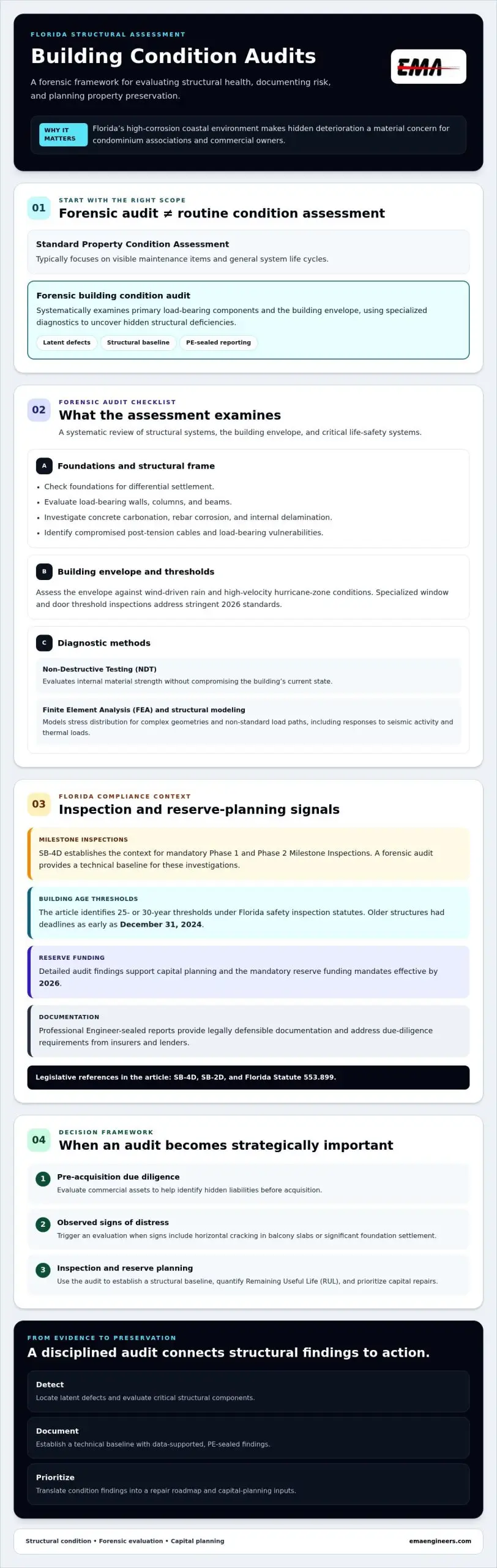
We define a building condition audit as a systematic, forensic examination of a structure’s primary load-bearing components and building envelope. Unlike a standard Property Condition Assessment, which typically focuses on visible maintenance items and general system life cycles, a forensic audit employs specialized diagnostic tools to uncover hidden structural deficiencies. In the Florida market, this distinction is critical because superficial inspections often fail to detect the early stages of concrete carbonation or electrolytic corrosion within reinforced slabs.
To better understand the methodologies used during these evaluations, watch this helpful video:
The aggressive Florida climate, characterized by high chloride concentrations and extreme thermal loading, necessitates a higher frequency of specialized oversight. As building engineers in Florida, we recognize that deferred maintenance in a coastal zone can lead to catastrophic failure. Our forensic engineering team provides PE-sealed reports that serve as legally defensible documentation for condominium boards, developers, and institutional lenders. These reports go beyond simple observations, utilizing data to establish the structural baseline required for compliance with state safety programs.
The Objective of a Forensic Audit
The primary objective of a forensic building condition audit is the identification of latent defects, such as internal delamination or compromised post-tension cables, that general inspectors frequently overlook. We focus on quantifying the Remaining Useful Life (RUL) of critical elements to assist associations in meeting the Structural Integrity Reserve Study (SIRS) requirements. This process establishes the essential technical baseline for the mandatory Phase 1 and Phase 2 Milestone Inspections dictated by SB-4D.
When to Schedule an Audit
Scheduling an audit is a strategic necessity during pre-acquisition due diligence for commercial assets to prevent the assumption of hidden liabilities. Owners should also trigger an audit immediately upon observing signs of distress, including horizontal cracking in balcony slabs or significant foundation settlement. Finally, these audits are mandatory for buildings reaching the 25 or 30-year thresholds under Florida’s current safety inspection statutes, with deadlines as early as December 31, 2024, for older structures.
The Comprehensive Building Condition Audit Checklist
A rigorous building condition audit requires a systematic departure from standard maintenance walkthroughs. We focus on the forensic identification of structural decay that remains invisible to the untrained eye. Our checklist prioritizes the primary load-bearing assembly, the building envelope, and critical life-safety systems to ensure total alignment with Florida Statute 553.899. This methodical approach allows us to transform raw physical data into a prioritized roadmap for capital preservation.
Structural Integrity and Load-Bearing Components
We evaluate foundations for signs of differential settlement and verify HUD foundation compliance for applicable multi-family structures. For the structural frame, we analyze load-bearing walls, columns, and beams to detect early-stage concrete carbonation and rebar corrosion. When encountering complex geometries or non-standard load paths, we utilize Finite Element Analysis Jacksonville FL to model stress distribution. This advanced modeling predicts how a structure reacts to non-linear forces like seismic activity or thermal loads. We supplement these models with Non-Destructive Testing (NDT) to evaluate internal material strength without compromising the building’s current state.
Building Envelope and Thresholds
The building envelope must withstand intense wind-driven rain and high-velocity hurricane zones. We conduct specialized window and door threshold inspections to meet the stringent 2026 standards. This audit includes verifying the hurricane impact ratings of all openings and assessing the waterproofing integrity at expansion joints and sealants. For roofing systems, our forensic analysis focuses on wind uplift resistance and drainage efficiency. We don’t just look for leaks; we analyze the system’s ability to resist the pressures of a major storm event.
Mechanical, Electrical, and Balcony Systems
Balconies and walkways are subject to DBPR HR-7020 compliance for hotels and condominiums. We inspect these elements for structural delamination and railing stability. Simultaneously, our team audits Mechanical, Electrical, and Plumbing (MEP) systems. This involves pressure testing fire protection lines and performing life-cycle cost analysis on HVAC units to ensure functional adequacy. If you’re managing an aging asset, our forensic engineering experts provide the PE-sealed documentation necessary to satisfy lenders and insurers. We ensure every mechanical and structural component is verified with clinical precision.
- Foundations: Verification of HUD compliance and settlement monitoring.
- Structural Frame: NDT testing for spalling and FEA for stress distribution.
- Envelope: Threshold compliance and wind uplift resistance.
- MEP: Electrical safety audits and fire protection pressure testing.
Navigating Mandatory Florida Milestone Inspections (SB-4D)
In Florida, the transition from a voluntary building condition audit to a mandatory milestone inspection represents a fundamental shift in property management accountability. Senate Bill 4-D mandates these evaluations for condominium and cooperative buildings three stories or higher. For structures within three miles of the coastline, the initial inspection is required by December 31st of the year the building reaches 25 years of age; all others must comply by their 30th year. Subsequent inspections occur every 10 years. This ensures that structural integrity remains a constant priority rather than a periodic concern.
The legislative framework also introduces the Structural Integrity Reserve Study (SIRS). This is a critical component of long-term financial stability. Associations must integrate data from a comprehensive building condition audit with a Facility Condition Assessment for capital planning to establish a 30-year funding roadmap. As of January 1, 2025, it’s no longer permissible to waive or underfund reserves for structural components. Full reserve funding must begin by January 1, 2026. Failure to comply can lead to significant civil penalties, the cancellation of master insurance policies, and exclusion from conventional mortgage financing.
Step 1: The Phase 1 Visual Inspection
The initial phase involves a qualitative assessment conducted by licensed professionals to determine if substantial structural deterioration exists. We perform unit-by-unit balcony and window perimeter checks to identify signs of distress like cracking or corrosion. It’s the responsibility of Building Engineers in Florida to certify whether the structure is safe for continued occupancy. If the Phase 1 report indicates significant issues, the association must proceed to Phase 2 within a strictly defined timeframe. We focus on detecting vulnerabilities before they escalate into systemic failures.
Step 2: Phase 2 Forensic Testing
When visual evidence suggests deep-seated vulnerabilities, we initiate Phase 2 forensic testing. This involves advanced methodologies such as ground-penetrating radar, core sampling, and non-destructive testing to quantify the extent of the damage. We then develop a detailed remediation plan with PE-sealed specifications. These plans satisfy both municipal building departments and the Board of Rules and Appeals (BORA). This phase ensures that repair strategies are based on empirical data rather than superficial observations. Precision in this stage prevents costly over-engineering or inadequate repairs.
Request a PE-sealed milestone inspection for your Florida property.
Interpreting Audit Results for Capital Planning
The conclusion of a building condition audit marks the transition from forensic discovery to strategic asset management. We categorize findings into distinct risk tiers to ensure that immediate life-safety hazards receive priority over secondary maintenance items. For institutional owners and condominium associations, this prioritization is the essential difference between a controlled expenditure and a catastrophic financial liability. We utilize the audit data to benchmark the health of the asset, allowing stakeholders to make informed decisions regarding the allocation of reserve funds mandated by Florida law.
Structural due diligence is paramount in commercial transactions and insurance negotiations. A professional audit provides an objective, empirical baseline that uncovers potential liabilities that standard inspections frequently miss. These forensic insights are particularly valuable when resolving insurance claim disputes following a hurricane event. A PE-sealed report serves as an authoritative record of a building’s pre-loss condition. This documentation prevents insurers from incorrectly attributing storm-related damage to pre-existing wear and tear, securing the funding necessary for proper restoration.
The cost of inaction in Florida’s high-corrosion coastal environment is non-linear. Deferred maintenance on a multi-million dollar structure leads to exponential structural risk. For example, untreated concrete spalling can lead to a significant loss in local load-carrying capacity within a few years of the initial observation. By identifying these issues early through a systematic building condition audit, owners can mitigate the compounding effects of rebar corrosion and moisture intrusion before they require invasive structural reconstruction.
Forensic Reporting and Documentation
Interpreting our technical reports requires a familiarity with specialized engineering terminology. We provide a Structural Due Diligence Guide to help stakeholders navigate complex data sets regarding stress distribution and material fatigue. These documents are designed to be legally defensible and are frequently utilized to satisfy the rigorous requirements of local building officials and the Board of Rules and Appeals (BORA). We ensure that every recommendation is grounded in empirical data and aligned with current Florida Building Code standards.
Next Steps: From Audit to Remediation
Once the audit is complete, the transition to remediation must be managed with clinical precision. We assist stakeholders in selecting qualified contractors who possess the technical capability to adhere to our precise engineering specifications. For complex failure analysis or post-audit monitoring of multi-million dollar coastal structures, consulting with Elite Forensic Engineers in Jacksonville ensures that every repair is verified for long-term functional excellence. This methodical oversight protects the asset’s integrity and ensures total compliance with the 2026 window and door threshold standards.
Securing Structural Longevity and Statutory Compliance
Managing a high-value coastal asset in Florida requires a shift from reactive maintenance to disciplined, data-driven oversight. We’ve established that a professional building condition audit is the only reliable method for identifying latent structural defects before they escalate into systemic failures. By integrating advanced methodologies like Finite Element Analysis and non-destructive testing, property owners can satisfy the rigorous requirements of SB-4D Milestone Inspections while securing their financial future through accurate reserve studies.
Our team of Licensed Professional Engineers brings over 40 years of forensic experience to every engagement. As Florida SB-4D compliance experts, we ensure your property remains a safe, insurable, and marketable asset. Whether you’re addressing immediate safety concerns or preparing for the 2026 threshold standards, our PE-sealed documentation provides the technical authority needed to resolve disputes and guide remediation with clinical precision.
Proactive structural management is the most effective safeguard against the compounding risks of the Florida climate. We’re here to help you achieve functional excellence and long-term stability for your property.
Frequently Asked Questions
What is the difference between a building condition audit and a home inspection?
A building condition audit is a forensic engineering evaluation focused on structural integrity and functional adequacy, whereas a home inspection is a general visual assessment of a residential property. While home inspectors look for surface-level maintenance issues, our engineers use advanced methodologies like non-linear analysis to identify latent defects. This technical depth ensures that load-bearing components are verified against current building codes and safety standards.
How much does a building condition audit cost for a commercial property in Florida?
The cost of a forensic audit for a commercial property depends on the structure’s square footage, age, and the complexity of its load-bearing systems. Factors such as the requirement for non-destructive testing or Finite Element Analysis influence the total investment. We recommend a customized consultation to define the scope of work necessary for your asset, as every property presents unique structural challenges and regulatory requirements.
Is a building condition audit required by Florida law for all condos?
Florida law mandates milestone inspections for all condominium and cooperative buildings that are three stories or higher. Under SB-4D, structures must undergo these audits when they reach 30 years of age, or 25 years if located within three miles of the coastline. These requirements ensure that aging infrastructure remains safe for occupancy through periodic professional engineering oversight and mandatory reserve funding for critical components.
What happens if a building condition audit reveals significant structural damage?
If a building condition audit reveals substantial structural deterioration, the engineer must notify the local building official and outline a remediation plan. This often triggers a Phase 2 inspection, which involves more intensive forensic testing to determine the precise extent of the damage. We then provide PE-sealed repair specifications to guide contractors in restoring the structure’s integrity and ensuring total legal compliance.
How long does it take to complete a full forensic building condition audit?
A full forensic audit typically takes between several days and several weeks to complete, depending on the building’s scale. The timeframe includes the initial on-site data collection, laboratory analysis of material samples, and the development of the final PE-sealed report. Complex structures requiring extensive structural modeling or moisture intrusion analysis will necessitate a more prolonged investigation period to ensure clinical precision and accuracy.
Can a building condition audit help reduce my commercial property insurance premiums?
A building condition audit can help reduce commercial property insurance premiums by providing empirical evidence of a structure’s health and risk mitigation efforts. Insurers often view PE-sealed documentation as a sign of proactive management, which can lead to more favorable underwriting terms. Demonstrating compliance with the latest hurricane impact and threshold standards reduces the perceived liability for the carrier, potentially lowering your annual costs.