

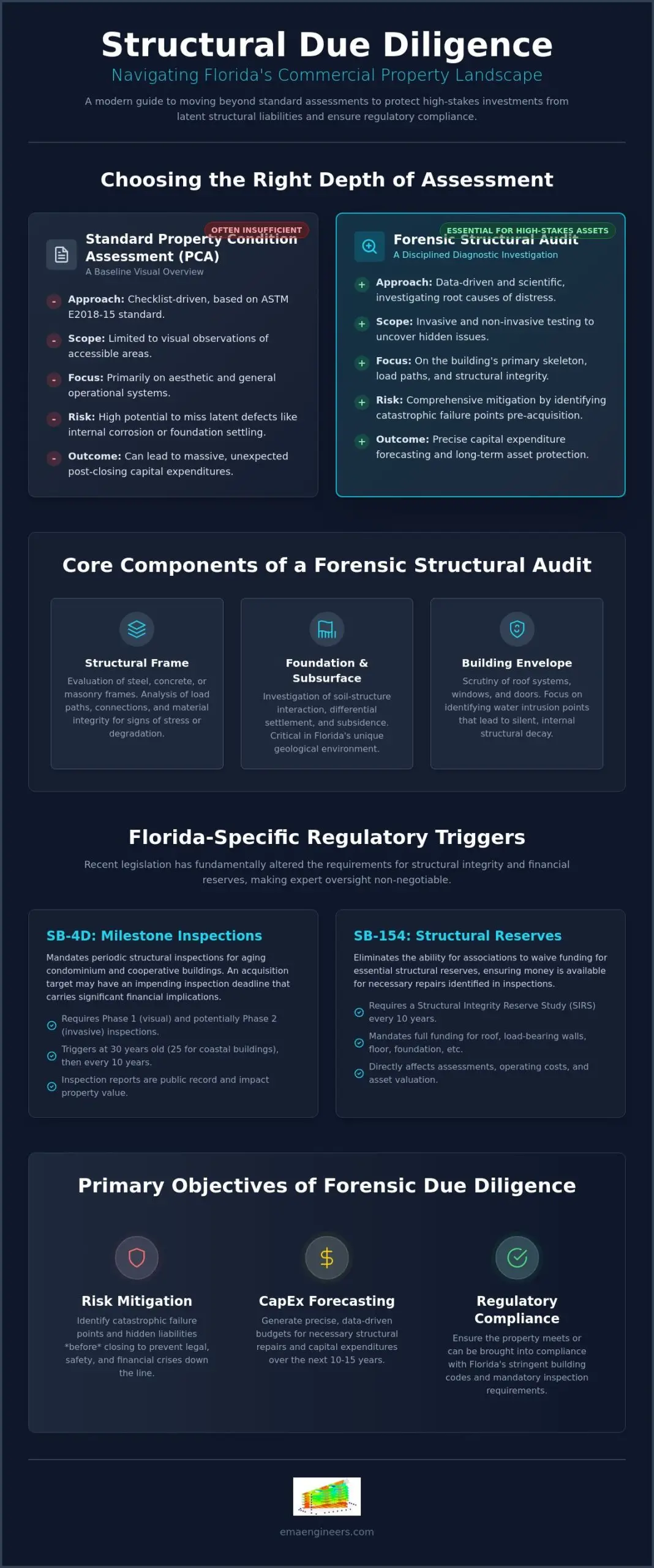
A standard property condition assessment is no longer a sufficient shield against the specialized structural liabilities inherent in Florida’s rigorous regulatory environment. For high-stakes acquisitions, relying on a generalist to identify deep-seated issues like coastal corrosion or foundation settling is a risk that often results in massive, post-closing capital expenditures. Mastering structural due diligence for commercial properties requires a shift from a checklist-driven approach to a disciplined forensic engineering audit. It’s the only way to ensure your investment remains viable under the weight of evolving safety mandates.
We understand the pressure to maintain compliance while minimizing risk in a market where SB-4D and SB-154 have fundamentally altered the landscape. This guide provides the technical clarity you need to navigate Florida Milestone Inspection requirements and accurately estimate repair costs before you commit to a deal. You’ll learn how to leverage expert structural oversight to secure your assets and gain a precise understanding of the long-term physical integrity of your portfolio.
Key Takeaways
- Distinguish between baseline visual inspections and invasive forensic investigations to uncover latent structural defects before they become liabilities.
- Execute structural due diligence for commercial properties using a methodology that evaluates original design intent against current physical degradation.
- Determine when a standard Property Condition Assessment (PCA) is insufficient and a deeper Forensic Structural Audit is required for comprehensive risk mitigation.
- Navigate the complexities of Florida’s SB-4D and SB-154 to ensure your potential acquisition meets mandatory Milestone Inspection and structural reserve requirements.
- Leverage technical oversight to generate precise capital expenditure estimates and protect the long-term functional excellence of your commercial assets.
What is Structural Due Diligence for Commercial Properties?
Structural due diligence for commercial properties isn’t a mere administrative checkbox; it’s a rigorous technical evaluation of a building’s load-bearing integrity. While standard property inspections focus on aesthetic and operational systems, this specialized audit examines the primary skeleton of the asset. It involves a systematic review of the structural frame, load paths, and connection points to ensure the building can safely withstand its intended loads and environmental stresses. In 2026, this process has become the baseline for protecting capital in high-density markets.
Most baseline assessments are limited to visual observations of accessible areas. However, high-stakes transactions often require Forensic engineering, which utilizes scientific methods and diagnostic tools to investigate the root causes of observed distress. This deeper level of analysis might include ground-penetrating radar for foundation checks or moisture meters to identify hidden corrosion in reinforced concrete. The distinction between a “look” and an “investigation” is often the difference between a profitable acquisition and a distressed asset.
The threshold for acceptable due diligence has shifted significantly due to aging infrastructure and stricter safety mandates. Investors must prioritize three primary objectives during this phase:
- Risk Mitigation: Identifying catastrophic failure points before they lead to legal or safety crises.
- CapEx Forecasting: Establishing accurate budgets for structural repairs over the next 10 to 15 years.
- Regulatory Compliance: Ensuring the property meets current Florida building codes and milestone inspection triggers.
The Core Components of a Structural Audit
A comprehensive audit focuses on the primary structural frame, whether it’s composed of structural steel, reinforced concrete, or masonry. Engineers evaluate foundation stability and soil-structure interaction, looking for signs of differential settlement or subsidence. The building envelope, particularly roof systems and window or door thresholds, is also scrutinized. These transition points are frequent sites for water intrusion. If left unchecked, moisture leads to the silent degradation of internal structural members.
Why Investors Can No Longer Rely on Seller Disclosures
Sellers often lack the technical expertise to identify latent structural defects. Issues like rebar oxidation or concrete spalling can exist for years without showing obvious external symptoms. Expert analysis uncovers the hidden history of an asset, such as unrecorded hurricane repairs or non-compliant modifications. Missing these details can lead to a significant devaluation of the commercial asset post-closing. Repair costs for structural members are exponentially higher than those for cosmetic finishes, making technical oversight a financial necessity.
The Forensic Engineering Approach to Property Assessments
Forensic engineering transforms structural due diligence for commercial properties into a data-driven diagnostic exercise. While a standard Property Condition Assessment often relies on the ASTM E2018-15 standard for a baseline visual overview, a forensic approach utilizes scientific methodology to identify latent defects. We act as a reliable guardian for your capital, moving beyond surface-level observations to investigate the root causes of physical distress. This disciplined process ensures that precursors to structural failure are identified long before they manifest as catastrophic liabilities.
A central component of this methodology is the reconciliation of original design intent with current physical reality. We meticulously review original blueprints, particularly for assets constructed in the 1970s and 1980s, to verify that the load-bearing paths remain intact. Discrepancies between historical documents and the building’s current state often reveal undocumented modifications or unrecorded repairs that can compromise the asset’s integrity. To achieve this level of precision, our engineers utilize high-resolution drones for envelope analysis, ground-penetrating radar (GPR) to map internal reinforcement, and moisture sensors to detect hidden electrolyte activity within concrete members.
Foundation and Subsurface Investigation
Florida’s unique geology necessitates a specialized focus on subsurface stability during the acquisition phase. We analyze crack patterns in slabs and masonry to distinguish between minor thermal expansion and significant differential settlement. In regions prone to sinkhole activity, our team evaluates the soil-structure interaction to ensure long-term stability. For specific asset classes, we also conduct HUD foundation inspections to verify compliance with federal standards, providing a comprehensive risk profile for the property’s most critical components.
Coastal Challenges: Corrosion and Salt-Air Impact
Commercial assets in West Palm Beach, Tampa, and Clearwater face relentless environmental stressors that accelerate structural degradation. Salt-air intrusion leads to rebar oxidation, which causes the concrete “spalling” frequently seen in parking garages and high-rise facades. We integrate specialized balcony inspections into the due diligence scope to identify these issues early. Detecting corrosion in its infancy allows investors to forecast repair costs accurately, preventing the financial shock of mandatory structural remediations shortly after closing. This technical oversight is essential for maintaining functional excellence in Florida’s coastal markets.
PCA vs. Structural Forensic Audits: Choosing the Right Depth
The Property Condition Assessment (PCA), governed by the ASTM E2018 standard, serves as the industry baseline for evaluating physical assets. It provides a broad overview of a building’s condition but often lacks the technical granularity required for high-stakes acquisitions. When executing structural due diligence for commercial properties, investors must decide if a visual walkthrough is sufficient or if the asset’s age, location, or complexity demands a forensic structural audit. Relying on a “rubber-stamp” inspection in high-liability markets like Florida can lead to unforeseen liabilities that far exceed the initial cost of a professional engineering review.
Establishing the correct depth of investigation is a matter of fiduciary responsibility. A standard PCA might suffice for a recently constructed warehouse with a simple steel frame. However, for multi-family complexes, aging high-rises, or properties subject to Florida Statute 553.899, a forensic audit is mandatory to ensure the structure remains sound and compliant. The return on investment for a deeper audit is realized through the avoidance of “hidden” costs that generalists frequently overlook during a cursory walk-through.
Limitations of the Standard PCA
PCAs are typically non-invasive and often performed by generalist inspectors who lack the specialized training of a structural engineer. While they can identify visible cracks or roof leaks, they often miss the complex failure points hidden within a building’s load-bearing system. This is particularly dangerous for buildings over 30 years old. At this stage, latent defects like concrete carbonation or foundation settlement are more likely to exist. A generalist doesn’t have the diagnostic tools or the professional liability coverage to confirm what’s happening beneath the surface.
The Value Proposition of a Forensic Structural Review
A forensic audit provides a detailed roadmap for future expenditures by quantifying repair costs for 5, 10, and 20-year CapEx plans. This precision gives buyers significant technical leverage during the cure period. If an engineer identifies specific structural remediation needs, that data becomes a powerful tool for negotiating price drops or repair credits based on objective evidence. Additionally, a forensic review ensures the asset remains insurable. In a tightening insurance market, carriers increasingly require proof of structural integrity before extending coverage. Investing in technical oversight during structural due diligence for commercial properties isn’t just about safety; it’s a strategic move to protect the long-term valuation of the asset.
Florida-Specific Triggers: SB-4D and Milestone Inspections
Florida’s legislative framework has established the most stringent safety requirements in the United States, fundamentally changing the risk profile of older assets. For investors, structural due diligence for commercial properties in Florida is now inextricably linked to Senate Bill 4-D (SB-4D) and its clarifying amendment, SB-154. These mandates require that any building three stories or higher must undergo a formal Milestone Inspection once it reaches a specific age threshold. While these laws primarily target condominiums and cooperatives, their reach extends to mixed-use assets and multi-family portfolios in major markets like Orlando and Tampa, where aging infrastructure is prevalent.
A critical component of this regulatory landscape is the Building Structural Integrity Reserve Study (SIRS). This study identifies the remaining useful life of primary structural components and dictates the necessary reserve funding for their eventual replacement. As of December 31, 2024, Florida law prohibits associations from waiving or reducing these reserves for essential structural items. For a commercial buyer, an incomplete SIRS or an underfunded reserve account represents a significant, immediate liability that must be accounted for during the underwriting process to avoid unexpected post-closing assessments.
The Milestone Inspection Timeline
Determining if a target property is approaching its 25 or 30-year anniversary is the first step in technical due diligence. If the initial Phase One inspection reveals signs of substantial structural deterioration, the law mandates a Phase Two investigation. This second phase is often invasive and considerably more expensive, involving material testing and depth-analysis of the load-bearing frame. Savvy buyers use the status of these inspections as a powerful negotiation lever. A pending Phase Two requirement provides the technical evidence needed to justify a substantial reduction in the purchase price or a credit for anticipated remediation. To ensure your acquisition remains compliant with these evolving standards, it’s vital to secure professional Milestone Inspection services during the cure period.
Hurricane Damage and Resilience Assessments
In coastal regions, resilience is a structural necessity rather than an optional upgrade. We evaluate the impact of previous storm events by examining roof-to-wall connections and the integrity of hurricane straps. Our team also conducts specialized windows and doors threshold inspections to ensure the building envelope remains compliant with current wind-load standards. These assessments identify if the property is prepared for future events or if it harbors hidden damage from past seasons. Identifying these weaknesses early allows for an accurate CapEx forecast that prioritizes long-term stability over superficial aesthetics.
Partnering with EMA for Technical Oversight and Risk Mitigation
EMA Structural Forensic Engineers stands as the principled expert for high-stakes commercial acquisitions across the Florida peninsula. Since our founding in 1975, we’ve refined a methodology that integrates both structural design and forensic analysis to protect investment capital. Our geographic reach extends from Melbourne to Clearwater, covering the critical Orlando and Tampa markets with localized technical expertise. This dual proficiency allows us to not only identify current physical deficiencies but also understand the engineering intent behind the original construction. The process begins with a precise inquiry into the asset’s history and structural load paths, followed by on-site execution of forensic inspections, and concludes with a comprehensive structural report that serves as a definitive record of the building’s integrity.
We recognize the intense pressure of the inspection period within commercial contracts. Timelines are compressed, and the need for actionable technical data is immediate. EMA Structural Forensic Engineers prioritizes efficient execution without compromising the precision of our findings. We maintain disciplined communication channels between our engineering team, the buyer, and legal counsel to ensure all parties understand the technical implications of the structural due diligence for commercial properties before the cure period expires. Our reports categorize findings by severity, distinguishing between immediate safety concerns and long-term maintenance requirements. This allows for clear, objective dialogue during price negotiations or the establishment of repair escrows.
Expedited Due Diligence Reporting
Our reporting structure is designed to meet the rigorous demands of commercial closings. We provide clear, data-backed assessments that translate complex engineering findings into actionable business intelligence. By delivering these insights within the specified contract windows, we empower investors to mitigate risk without delaying the transaction. The steady stream of information provided during the audit ensures that no technical surprises emerge at the final hour, maintaining the integrity of the deal flow.
Beyond Acquisition: Long-Term Structural Management
Structural due diligence for commercial properties shouldn’t be viewed as a one-time event but as the foundation of a proactive asset management strategy. The findings from our initial audit form the basis of a long-term maintenance plan, allowing owners to prioritize repairs and manage reserve funding effectively. EMA Structural Forensic Engineers continues to serve as a reliable guardian through ongoing Structural Engineering Services, including mandatory threshold inspections, balcony assessments, and hurricane damage evaluations. By shifting from reactive fixes to methodical, planned maintenance, investors ensure the functional excellence and long-term valuation of their Florida real estate portfolios. Our commitment to accuracy and integrity ensures that your physical infrastructure remains a stable, high-performing component of your investment strategy.
Securing the Long-Term Viability of Your Commercial Assets
Navigating the complex physical and regulatory demands of the Florida market requires more than a cursory inspection. Effective structural due diligence for commercial properties depends on a forensic understanding of load-bearing integrity and a clear alignment with mandatory safety standards. By distinguishing between standard assessments and forensic audits, you ensure that every acquisition is backed by precise data and a realistic CapEx forecast. This disciplined approach protects your capital from hidden defects while ensuring full compliance with SB-4D requirements.
EMA Structural Forensic Engineers has served as a reliable guardian for property owners since 1975. Our team of Florida licensed professional engineers provides the specialized expertise necessary for mandatory Milestone Inspections and comprehensive forensic reporting. We deliver the technical clarity required for both high-stakes acquisitions and long-term insurance eligibility. Our methodical process ensures that your physical infrastructure remains a stable and predictable component of your business strategy.
Request a Structural Due Diligence Consultation with EMA Engineers to safeguard your investments with technical precision and principled oversight. We’re ready to help you maintain structural stability and functional excellence across your entire Florida portfolio.
Frequently Asked Questions
What is the difference between a building inspection and structural due diligence?
A general building inspection provides a broad overview of all systems, including HVAC, plumbing, and aesthetics, whereas structural due diligence for commercial properties is a specialized, technical evaluation focused exclusively on the load-bearing frame and foundation. Generalists often overlook latent defects that a structural engineer identifies through diagnostic analysis. This process ensures the building’s primary skeleton is capable of supporting its intended loads without risk of failure.
Is a Milestone Inspection required during commercial due diligence in Florida?
A Milestone Inspection is legally mandated for buildings that are three or more stories tall once they reach the 25 or 30-year age threshold under Florida’s SB-4D legislation. While not every commercial acquisition triggers an immediate requirement, identifying if a property is approaching these deadlines is a critical part of the due diligence process. Failing to account for this can lead to significant post-closing liabilities and mandatory repair costs for the new owner.
How long does a forensic structural engineering assessment typically take?
The duration of a forensic structural assessment typically ranges from one to three weeks, depending on the complexity and scale of the asset. This timeline includes the initial site investigation, material testing if necessary, and the delivery of a comprehensive report. We understand the time-sensitive nature of commercial contracts and work to align our technical oversight with your specific closing schedule to prevent delays in the transaction.
Will a structural engineer review the building’s original plans?
Reviewing the original blueprints and design documents is a fundamental step in a disciplined forensic methodology. It allows our engineers to reconcile the original design intent with the current physical state of the building. This comparison often reveals undocumented modifications, non-compliant additions, or historical repairs that might compromise the structural integrity of the property over time.
Does structural due diligence include an evaluation of the roof and foundation?
Evaluation of the roof and foundation is a core component of structural due diligence for commercial properties. These elements represent the most critical points of the building’s load-bearing system. Our engineers examine foundation stability for signs of differential settlement and assess the roof-to-wall connections to ensure the building envelope can withstand environmental stressors like high wind loads during storm events.
Can a structural engineering report help negotiate the purchase price?
A detailed structural engineering report serves as a powerful technical lever during purchase price negotiations. By identifying specific physical deficiencies and quantifying the anticipated cost of remediation, buyers can justify requests for repair credits or price reductions based on objective engineering data. This technical transparency ensures that the final valuation reflects the actual physical condition and future liability of the asset.
What are the signs that a commercial property needs a forensic structural audit?
Visible signs of structural distress include significant cracking in masonry, concrete spalling in parking structures, or uneven flooring that suggests foundation settlement. Additionally, any property over 30 years old or located in a high-corrosion coastal environment should undergo a forensic audit. These indicators suggest that latent issues may exist beneath the surface that require expert investigation to ensure long-term stability.
How does coastal location affect the scope of structural due diligence?
Coastal locations necessitate a more rigorous inspection scope focused on salt-air corrosion and hurricane resilience. Engineers prioritize the evaluation of reinforced concrete members for rebar oxidation and check the integrity of balcony and window thresholds. The accelerated rate of degradation in these environments requires a methodical approach to identify precursors to structural failure before they manifest as catastrophic and costly repairs.